Count your tabs.
Right now. How many browser tabs does your team have open? I'll guess. ChatGPT. Jasper. Canva. Google Docs. Facebook Ads Manager. A scheduling tool. Maybe Grammarly. A client's WordPress backend. Email, obviously. Slack.
That's ten tools open and nobody's done any actual work yet. They're just getting ready to start.
The subscription paradox
Every tool you added was supposed to save time. ChatGPT for drafting. Jasper for long-form. Canva for visuals. Each one made perfect sense when you bought it.
But nobody accounted for the space between them.
The copy-paste. The reformatting. The "which version is the latest?" conversations. The context switching. Your team opens ChatGPT, writes a prompt, waits, copies the output, opens Google Docs, pastes, reformats, realizes the tone is wrong, goes back to ChatGPT, rewrites the prompt, copies again.
That's not AI working for you. That's you working for AI.
I watched this happen at an agency I was consulting with
Eight people. Good team. Doing content and ads for about a dozen small businesses. They bought AI tools specifically to move faster.
Six months in, they were spending more time on content production than before they had the tools. Not because the tools were bad. Because every new subscription added a new context switch, and nobody connected any of it together.
Their junior coordinator — the person doing the actual production work — was spending her day as a human API. Copying data from one tool, translating it for another, pasting it into a third. She wasn't thinking. She wasn't strategizing. She was middleware.
She told me: "I spend more time moving things between tools than I do on the actual work."
That sentence has stuck with me.
The context switch tax
There's research on this. Gloria Mark at UC Irvine found it takes an average of 23 minutes to refocus after switching contexts. Twenty-three minutes.
Your team isn't switching once. They're switching 14 times a day. I know because we measured it for the workload demo inside Workilo. Fourteen context switches. Every day.
Not every switch costs 23 minutes. Some are quick. But even if you average 5 minutes of lost focus per switch, that's over an hour a day gone. Not on bad tools. On the space between good tools.
Multiply that by your team. Multiply that by 52 weeks.
That's where your margin went.
More tools is not the answer
The instinct is always to add another tool. "We need a project management layer." "We need a better scheduling tool." "We need something that connects ChatGPT to our CMS."
Each one sounds reasonable. Each one adds another tab, another login, another subscription, another thing someone has to learn and maintain and troubleshoot when it breaks.
I've seen agencies running five AI subscriptions that don't talk to each other. Not because integrated tools don't exist. Because they bought them one at a time, each solving a problem the last one created.
The tool that connects ChatGPT to your CMS creates a problem that requires a tool that monitors the connection. Now you have seven tools.
Fewer tools, not more
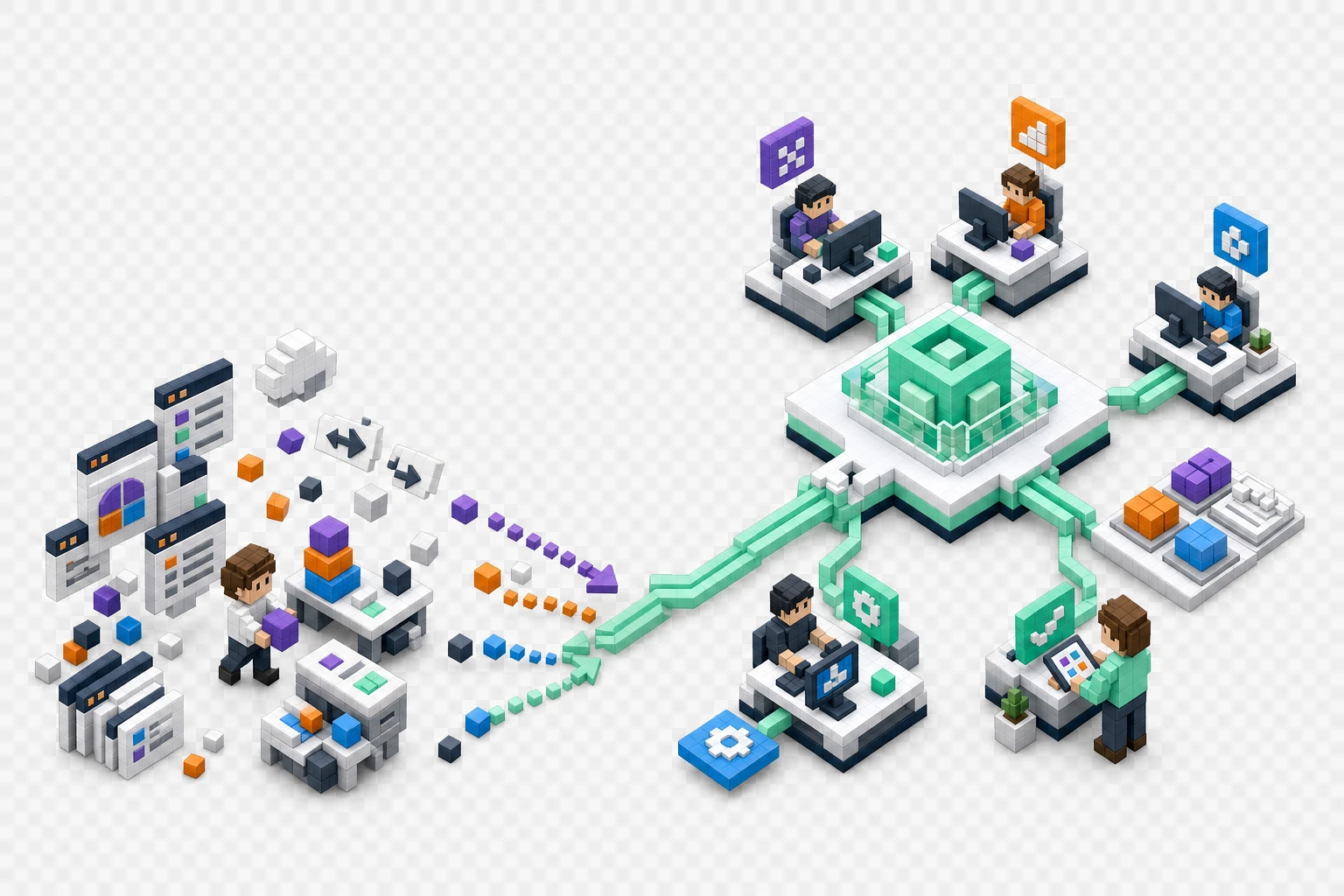
What if instead of connecting separate tools, you replaced them with one system where the work stays in one place?
Not one generalist chatbot. That's the trap everyone fell into already. One system with specialists who know their job — a content writer, a social media adapter, a designer, a project manager — that hand off to each other inside a single workflow.
The research feeds the draft. The draft feeds the social posts. The social posts go through an approval queue. The approved content publishes. No copy-paste. No browser tabs. No human middleware.
Your team's job shifts from moving content between tools to reviewing content that's already where it needs to be.
The question
I talk to agency owners every week. The conversation always starts the same way. They tell me about their tech stack. They list the tools. They describe the integrations they've tried.
I ask them one question: how many hours per week does your team spend moving work between tools versus doing the work itself?
Nobody has the answer. They've never measured it.
If you want to measure it, it takes 30 seconds.